Operating Systems for Quantitative Finance Jobs | QuantPact
Why quant developers need OS knowledge: page faults, scheduling and system calls that silently break low latency trading in quantitative finance.
By QuantPact Team · · 15 min read
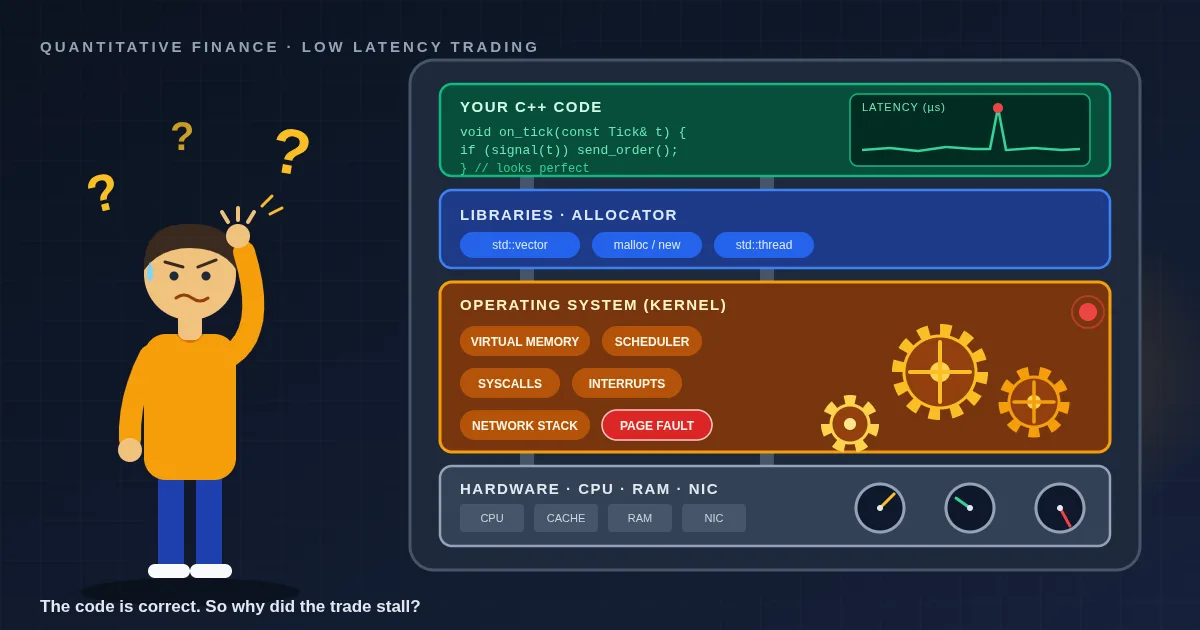
The trade that never happened
Here is a scenario that plays out, in one shape or another, inside quantitative finance firms around the world. (The details below are an illustrative composite, but every ingredient in it is real.)
It is a Tuesday. A strategy has been running smoothly since the open. The C++ code is clean, reviewed, and tested. It has traded thousands of times without a single error.
Then a piece of news hits the market. Prices jump. The strategy's signal fires, exactly as designed, and the order is ready to go.
But the order goes out late. Not catastrophically late, just late enough. By the time it reaches the exchange, the opportunity is gone. The fill is bad, or there is no fill at all.
The trader asks the quant developer the obvious question: "What happened?"
The developer opens the logs. No errors. No exceptions. No crash. The code ran exactly as written. The profiler shows the algorithm itself took its usual few microseconds. The network team says the network was healthy. The exchange says its side was fine.
Everyone has checked their own piece. Every piece looks perfect. And yet the trade did not happen the way it should have.
This is the moment that separates engineers who can build software from engineers who can build trading systems. And it is the reason I want you to hold onto one question for the rest of this article:
How can a perfectly correct C++ trading program, with no bug, no error, and no crash, suddenly freeze for just long enough to miss the most important trade of the day?
I will answer it. But the answer is more interesting if we first understand the thing most developers forget is even there.
"Why do I need to learn operating systems for a quant developer role?"
Students ask us this constantly, and honestly, it is a fair question.
You are preparing for quantitative finance roles. You are learning C++, data structures, maybe some probability and statistics. Operating systems sounds like a university course you survived and hoped to forget. Surely the quant developer job is about writing fast code, not about kernels and schedulers?
Here is the uncomfortable truth: your C++ program does not run on the hardware. It runs on the operating system, which runs on the hardware.
Every single thing your program does, from allocating memory to reading a network packet to printing a log line to simply being scheduled on a CPU, goes through the operating system. In ordinary software, the OS is invisible because it is fast enough and fair enough that you never notice it. In low latency trading, the OS is a silent teammate (or a silent saboteur) in every microsecond of your trade.
In quantitative finance, where a strategy can be won or lost in microseconds, this is not a detail. It is the difference between a system that works in testing and a system that works with real money on the line.
Think of it as a stack:
- Your strategy code (the part you wrote and understand)
- Libraries and the runtime (the allocator, the standard library)
- The operating system (memory manager, scheduler, network stack, system calls)
- The hardware (CPU cores, caches, memory, network card)
Most developers live entirely in layer one and assume layers two through four behave. Quant developers do not have that luxury. When something strange happens at 9:30 in the morning, the cause is as likely to be in layer three as in layer one.
A guided tour of what the OS is secretly doing to your trading code
Let's walk through the major parts of an operating system and see how each one can reach up and touch your trades. I will keep this at the surface on purpose. Each of these topics is a deep rabbit hole, and the goal here is to make you curious about what is down there.
1. Virtual memory and paging: the memory you think you have
When your program asks for memory, you picture a block of RAM sitting there, ready to use. That is not quite what happens.
The operating system gives each program a virtual address space, a convincing illusion of private, continuous memory. Behind the scenes, the OS maps small chunks of that illusion, called pages, onto real memory, and it often does so lazily, only when you actually touch them.
That illusion is wonderful for general computing and quietly dangerous for trading. Because "memory you have been given" and "memory that is ready to use right now" can be two different things.
A few questions to keep in your pocket: What happens the first time your code touches a page the OS has not really set up yet? What if the page was moved out of RAM to make room for something else? And why do some trading firms care so much about page size?
2. The scheduler and context switches: who gets the CPU?
Your server runs many things at once: your strategy, the market data handler, logging, monitoring agents, the OS's own housekeeping. There are more things that want to run than there are CPU cores, so the operating system scheduler decides, many times per second, which thread runs where.
From the scheduler's point of view, your trading thread is just another thread. If it decides something else deserves the core, your thread is paused mid-instruction and resumed later. The act of swapping one thread for another is a context switch, and it is far from free.
What does your trading thread lose when it is paused, even if it only waits for a moment? And what would it mean to tell the scheduler, "this core is mine, leave it alone"?
3. System calls and interrupts: crossing into the kernel
Your code runs in a restricted mode and is not allowed to touch hardware directly. To do anything meaningful, such as reading a file, sending a packet, or asking for more memory, it must ask the kernel through a system call. The CPU switches modes, the kernel does the work, and control returns to you.
Separately, the hardware itself can interrupt whatever is running to say, "a packet arrived" or "a timer fired." These interrupts can land on the very core your strategy is using.
How many system calls does your hot path make? Would you even know? And which core should an interrupt from your network card be allowed to land on?
4. Memory allocation: where new really goes
Calling new or malloc looks like a single, cheap operation. Underneath, it may involve a library allocator, which sometimes asks the kernel for more memory, which may need to find, map, and zero out fresh pages.
If you read our article on building an order book, you saw how a std::map allocates a node for every price level. Now imagine that allocation, on the hottest path in the system, occasionally triggering a trip into the kernel. Most of the time it is fast. Most of the time. In quantitative finance, "most of the time" is exactly where the damage hides.
5. Threads and synchronization: when waiting is a decision the OS makes
Multi-threaded trading systems share data between threads, such as a market data thread feeding a strategy thread. The moment two threads fight over a lock, the operating system gets involved: it may put one thread to sleep and wake it later.
What does it cost a thread to be put to sleep and woken up? And why do so many low latency trading systems go out of their way to avoid locks entirely?
6. The network stack: a long road for a small packet
A market data packet does not jump from the network card into your program. It travels through the card's buffers, the kernel's network stack, queues, and a copy into your program's memory before your code ever sees it. The same journey happens in reverse for your order.
Every stop on that road costs time and adds variation. Which is why some firms ask a radical question: do we need the kernel in this path at all?
7. Clocks and time: the clock you measure with is also a system service
Trading lives on timestamps. How long did the strategy take? When did the packet arrive? Which came first? Getting the current time is itself an operating system service, and different ways of asking for the time have very different costs and different accuracy.
If you are measuring latency with a clock that itself adds latency, what exactly are you measuring?
8. Files and logging: the innocent line that blocks the world
Every developer adds log statements. In a normal application, a log line is harmless. In a trading system, a log line is a request to the operating system to write to a file, which may involve a disk, a buffer, and a wait.
Could a single log("order sent") statement be the reason an order went out late? In some systems, yes. The more interesting question is how experienced teams log without paying for it.
9. NUMA and CPU caches: the geography inside the machine
A modern server is not one flat pool of memory. It has multiple CPU sockets, each with memory that is "close" to it and memory that is "far." The operating system decides, silently, where your program's memory physically lives and which core runs your thread.
What if your thread ran on one socket while your data sat next to the other? Everything would still work. It would just be slower in a way no profiler of your C++ code would explain.
All of this, at a glance
| OS component | What it does quietly | How it can show up in trading |
|---|---|---|
| Virtual memory / paging | Maps and moves memory pages on demand | Unexplained one-off stalls on first use of memory |
| Scheduler | Decides which thread runs on which core | Your thread paused at the worst moment |
| System calls | Moves execution into the kernel | Hidden cost in "simple" operations |
| Interrupts | Hardware steals a core briefly | Tiny periodic latency spikes |
| Memory allocator | Finds and prepares memory | Unpredictable new / malloc timing |
| Locks / threads | Puts waiting threads to sleep | Latency jumps under contention |
| Network stack | Moves packets through the kernel | Extra delay and variation on every message |
| Clock services | Provides timestamps | Measurements that mislead you |
| File I/O | Writes data to disk | A log line that blocks the trade |
| NUMA | Places memory near some cores, far from others | The same code running slower on some cores |
Notice the pattern in the third column. Almost none of these failures show up as errors. They show up as time. The code is correct. It is just not there when you need it. That is the defining feature of operating system problems in quantitative finance: they are invisible to everything except the clock.
Back to the question: what stopped the trade?
Now we can return to our silent Tuesday and answer the question we started with.
Let's walk through what likely happened. During the session, the strategy had been running one well-worn path through the code, the one that handled normal market conditions. But when the news hit, the strategy followed a path it rarely used. That path needed a chunk of memory that the program had asked for at startup but had never actually touched.
Remember virtual memory? The operating system had handed the program that memory as a promise, not as a ready-to-use reality. The first time the strategy actually reached into that memory, the CPU found that the page was not really there yet.
That event has a name: a page fault.
When a page fault happens, the CPU stops your code, hands control to the operating system, and waits. The kernel has to find a physical page, prepare it, update its bookkeeping, and only then let your program continue. If the data has to come all the way from disk, the wait grows from microseconds toward milliseconds. From your C++ code's point of view, nothing happened. One line simply took a very long time.
That is why there was no error. That is why the profiler of the algorithm looked fine. The algorithm ran quickly, but the program was paused by the operating system in the middle of it. The trade was not lost to a bug. It was lost to a few hundred microseconds of waiting for the kernel, at exactly the moment the market moved.
And the cruelest part is the timing. Paths that are rarely used are often exactly the paths that matter most: the unusual, high-volatility moments when money is made and lost.
If that makes you ask, "so how do trading firms stop this from happening?", good. That is precisely the right question, and it opens the door to a whole family of techniques that real quant developers use, from how memory is prepared before the market opens to how threads are isolated from everything else on the machine.
This is only one story
I want to be very clear about something. The page fault is one scenario, and it is one of the friendlier ones. Quantitative finance is full of problems that look like this: nothing is broken, everything is correct, and the system is still slow in a way nobody can immediately explain.
Here are a few more, to give you a flavor:
- A strategy that is fast all day but slow for the first few seconds after the open.
- Latency spikes that arrive at suspiciously regular intervals, like a heartbeat.
- Identical code that runs measurably faster on one core than another.
- A system that is blazing fast on the developer's laptop and sluggish on the production server.
- Rare stalls of about a millisecond that appear in no log and match no code path.
- A "harmless" monitoring tool that makes the trading process slower just by existing.
Each one of these has a cause that lives somewhere in the operating system or the hardware beneath it. Each one has a fix. And each one is the kind of problem that quant developers are paid to find in minutes while everyone else is still reading the logs.
The pattern behind them all is the same: you cannot optimize what you do not understand, and you cannot understand a trading system without understanding the operating system it runs on.
What interviewers will ask
If you are preparing for quant developer roles, expect operating system questions to appear, often disguised as "how would you debug this?" questions. For example:
- "Our strategy is occasionally slow, and the code looks fine. Where do you start?"
- "What happens, step by step, when your program touches memory for the first time?"
- "Why might the same program have different latency on different cores?"
- "What is the cost of a context switch, and how would you avoid it on a critical thread?"
- "Why do trading systems often avoid system calls on the hot path?"
- "How would you log from a latency-critical thread without slowing it down?"
Notice that none of these ask you to recite a definition. They ask you to reason about a live system. Candidates who only know algorithms freeze here. Candidates who understand how the OS works can narrate the answer.
For more on what to expect, see our guide to quant developer interview questions.
Ready to look under the hood?
In this article, we used one real-world scenario to show how the operating system can quietly decide the outcome of a trade. But there is only so much an article can teach. Reading about a page fault is very different from designing a program that avoids one, or tracking one down on a live trading system while the market is moving. If you are serious about building a career in quantitative finance, you need to go much deeper than a single story.
In our cohort, we do exactly that. We take a deep dive into every aspect, starting from how to design your program so these problems do not show up in the first place, all the way to how to debug such a scenario in a live trading system. It is taught through real scenarios like this one and tied back to the C++ you are already learning. The goal is to make you the person in the room who knows where to look when the logs say everything is fine. If you want to move from "my code is correct" to "my system is fast, and I can prove why," this is the next step.
Check out the cohort and enroll here →
A closing thought
Go back to that quant developer staring at clean logs in afternoon. The engineer who stays stuck keeps re-reading code that is already correct. The engineer that firms fight to hire does something different. They ask what the operating system was doing at that exact moment, check the page-fault counters, find the cold path nobody had warmed up, and make sure it never costs a microsecond again. Same code. Same market. Same Tuesday. One engineer has no answer. The other has a diagnosis, a fix, and a system that is ready the next time the market moves.
You might also like our deep dives on the order management system (OMS) and on building an order book in C++, which show how these ideas connect to the rest of a trading system.
Frequently asked questions
Why do quant developers need to learn operating systems?
Because trading code runs on top of the operating system, and the OS controls memory, scheduling, networking, and timing. In low latency trading, many delays come from the OS (such as page faults and context switches) and never appear as errors in your C++ code.
What is a page fault, and why does it matter in trading?
A page fault happens when a program touches memory the operating system has not yet made ready. The CPU pauses the program while the kernel handles it. In quantitative finance, even a brief pause at the wrong moment can mean a missed or badly priced trade.
Which operating system do trading firms use?
Most low latency trading systems run on Linux, because it offers fine control over scheduling, memory, and networking. Understanding Linux internals is therefore a major advantage for quant developer roles.
What is a context switch?
A context switch is when the operating system pauses one thread and runs another on the same CPU core. It costs time and disturbs the CPU's caches, which is why latency-critical trading threads are usually protected from being switched out.
Are operating system questions asked in quant developer interviews?
Yes. They often appear as debugging or system design questions, such as why a correct program is occasionally slow. They test whether you understand what happens beneath your code.
Key takeaways
- Your C++ trading code runs on the operating system, and the OS can delay it without causing any error.
- Virtual memory, the scheduler, system calls, interrupts, allocation, locking, the network stack, clocks, file I/O, and NUMA all affect trading latency.
- A page fault on a rarely used code path is a classic example of a correct program that still misses a trade.
- OS-level problems show up as time, not as errors, which is why they are so hard to find without the right knowledge.
- This is one scenario among many, and quantitative finance firms hire quant developers who can diagnose them.