Why Not Java or Python for Low-Latency Trading?
Why HFT firms build their hot path in C++ instead of Java or Python: garbage-collection pauses, JIT warm-up, interpreter overhead, and why tail latency matters more than average speed.
By QuantPact Team · · 9 min read
I often get this question from students:
"Why can't we use Java or Python for low-latency trading? Why is C++ so widely used in HFT?"
And honestly, that's a fair question.
Java powers some of the world's largest enterprise applications. Banks, payment gateways, distributed systems and financial institutions rely on it to process millions of transactions.
Python, on the other hand, has an incredible ecosystem. From data analytics and scientific computing to machine learning and quantitative research, it makes complicated things remarkably easy. Why build something from scratch when a library can do the job for you?
So, if Java can handle millions of transactions and Python can process enormous amounts of data, why do low-latency trading firms continue to invest so heavily in C++?
Is C++ simply faster?
Or is there something more fundamental happening beneath the surface?
Let's understand this through a real-world trading scenario.
Imagine You're Running a Trading Firm
Your trading system is watching the same instrument on two exchanges.
On Exchange A, someone is offering to sell it at ₹1,000. On Exchange B, someone is bidding ₹1,005 for it.
Your strategy spots the gap: buy on Exchange A, sell on Exchange B, and pocket ₹5 per unit.
On its own, ₹5 doesn't sound like much. But trading firms capture opportunities like this thousands of times a day, often in large size, and those small edges add up quickly.
But there's a catch.
Every other fast trader can see the same gap. Whoever gets their orders to the exchange first gets the trade. Everyone else gets nothing.
Your strategy generates an order and sends it to the Order Management System (OMS), which is responsible for managing and routing orders to the exchange.
Let's follow the journey.
The Trade Execution Journey
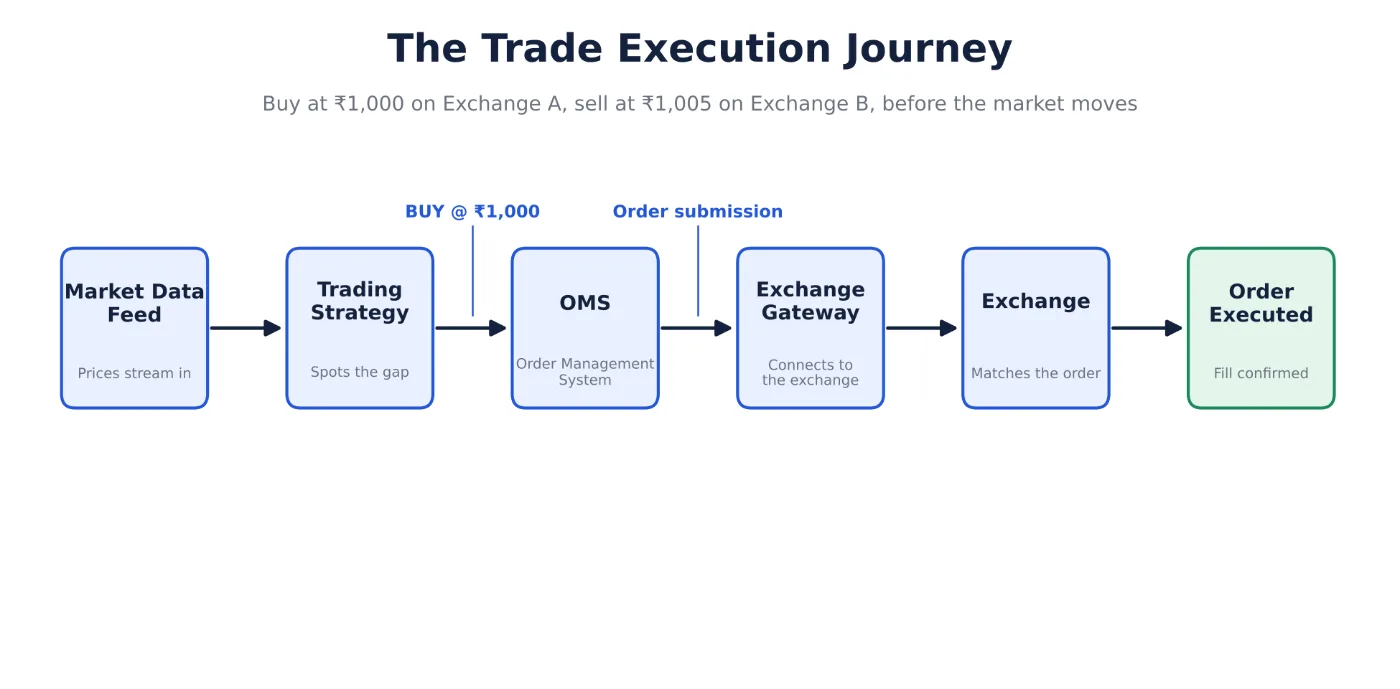
Everything looks straightforward.
Your strategy identifies an opportunity, the OMS routes the order, and the exchange executes it.
But let's introduce one small problem.
What if your application pauses right when the order needs to be sent?
Your strategy has generated the order. Your OMS is ready to process it. But the application suddenly stops making progress for a few milliseconds.
By the time execution resumes, the opportunity is gone.
The market has moved. Someone else has taken the liquidity.
You haven't necessarily lost money on an executed trade. You've lost the opportunity to execute a potentially profitable trade.
Worse, if only one side of the trade got through before the pause, you might now be holding a position you never wanted, at a price that has already moved against you.
In high-frequency trading, these distinctions matter enormously.
So, what could cause your application to stop making progress?
One possible culprit in a Java application is something called Garbage Collection (GC).
The Hidden Cost of Garbage Collection in Java
Java is an incredibly powerful language, and one of its biggest advantages is automatic memory management.
Unlike C++, developers generally don't need to manually allocate and release memory.
Consider this simple Java example:
public class Order {
    int price;
    int quantity;

    public Order(int price, int quantity) {
        this.price = price;
        this.quantity = quantity;
    }
}
Every time you create an order:
Order order = new Order(1000, 100);
The JVM allocates memory for that object on the heap.
Now imagine your trading application processing hundreds of thousands or millions of market updates every second.
During this process, it might create temporary objects for:
- Incoming market data messages
- Order representations
- Execution reports
- Intermediate calculations
- Temporary collections and other data structures
Most of these objects are needed for only a few microseconds. After that, nothing in the program refers to them anymore.
But the memory they occupy can't simply stay occupied forever.
The JVM needs to identify objects that are no longer being used and reclaim their memory.
This is where the Garbage Collector comes into the picture.
What Happens During Garbage Collection?
At a high level, a garbage collector identifies objects that are no longer reachable and reclaims the memory they occupy.
Some garbage collection phases require all application threads to pause.
These pauses are commonly referred to as Stop-The-World (STW) pauses.
Here's what that means for our trading application:
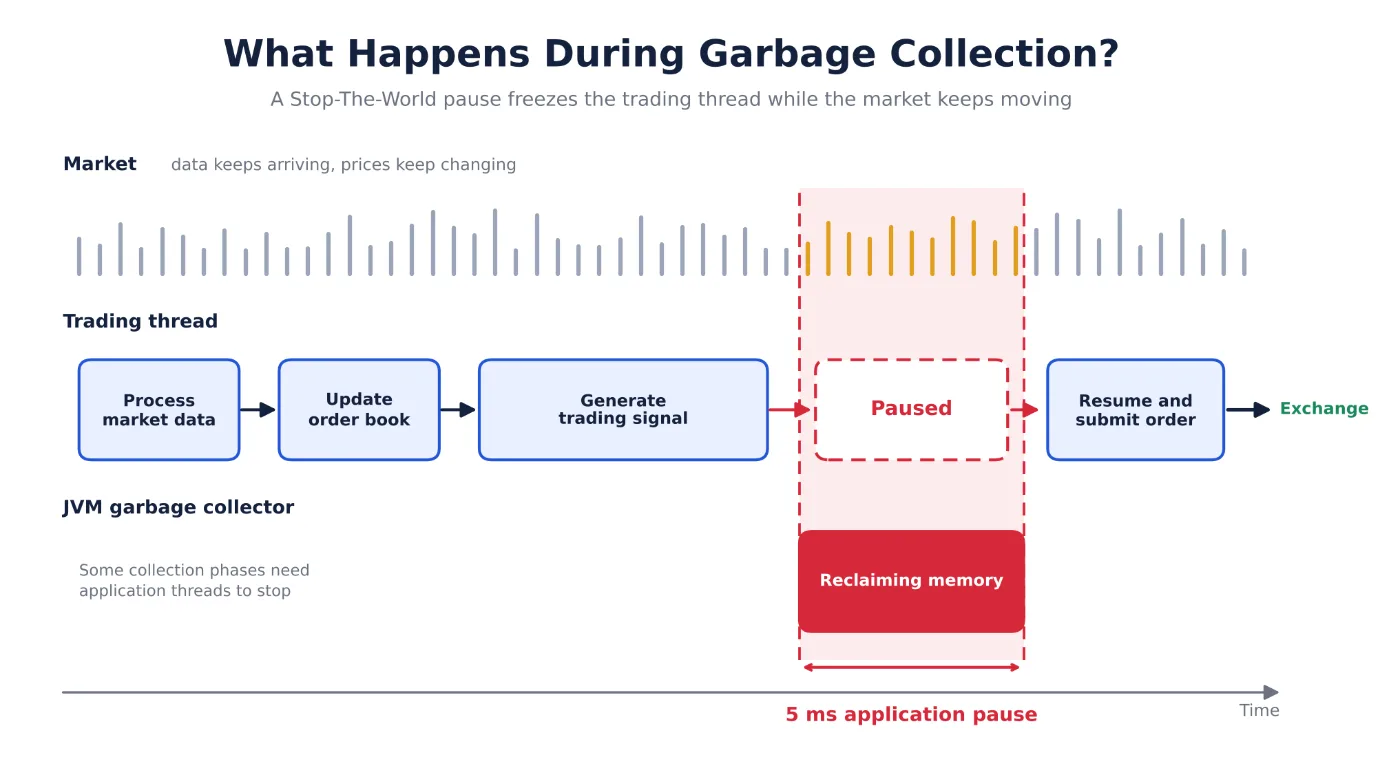
While the application is paused, the trading thread can't do anything at all.
The market, however, doesn't stop.
New market data keeps arriving. Prices keep changing. Other participants keep submitting orders.
And your trading application is temporarily unable to react.
Now imagine this happening during a critical market event, like an economic data release, when prices move the fastest and the opportunities are the biggest.
In a world where competitors react in microseconds, a pause of a few milliseconds is an eternity. One millisecond is a thousand microseconds.
This is the fundamental concern with garbage collection in latency-sensitive applications: unpredictable pauses, and their impact on tail latency.
"But Modern Java Has Solved This, Right?"
Partly, and it's worth being precise here.
Modern collectors like ZGC (production-ready since JDK 15, generational since JDK 21) do most of their work concurrently, while your application keeps running. Their pauses are typically well under a millisecond. Commercial JVMs such as Azul's Platform Prime go further still.
Serious low-latency Java shops also write garbage-free code in the hot path. They preallocate objects, reuse them, and avoid creating new ones while trading, so the collector has almost nothing to do. The LMAX Disruptor, a well-known high-performance messaging library, came out of exactly this style of Java engineering at a trading venue.
So yes, Java can be made fast and fairly predictable. Some trading firms run Java in production for exactly this reason.
But notice what that takes: you end up fighting the language's defaults. You avoid much of the standard library, take care not to trigger hidden allocations, and tune the JVM carefully.
GC isn't the only source of jitter either:
- JIT warm-up. Java code starts out running slowly and gets compiled into fast machine code only once the JVM has seen it run many times. The first orders of the day can be the slowest, so firms often "warm up" their systems with fake traffic before the market opens.
- Deoptimisation. If the JVM's assumptions about your code turn out to be wrong, it can throw away compiled code and fall back to slower execution in the middle of the trading day.
- Safepoints. Various JVM housekeeping tasks also briefly pause application threads, and not only for garbage collection.
And What About Python?
Python's problem is different, and more fundamental.
Python is excellent for research, but the standard interpreter (CPython) is simply not built for microsecond-level execution:
- It's interpreted. Every line of Python goes through the interpreter, which adds overhead to each operation. Pure Python loops are commonly 10–100x slower than equivalent C++.
- Everything is an object. Even a simple integer is an object on the heap, with type information and a reference count. Adding two numbers involves far more work than a single CPU instruction.
- The GIL. In standard CPython, the Global Interpreter Lock lets only one thread run Python code at a time. Python 3.14 officially supports an optional free-threaded build without the GIL, but it's still new, and many libraries aren't fully ready for it.
- It has garbage collection too. CPython frees most objects immediately using reference counting, but it also runs a periodic cycle collector that can pause the program.
Libraries like NumPy and pandas are fast because their heavy lifting happens in C and C++ under the hood. That's perfect for crunching a year of tick data in a backtest. It doesn't help when you have to react to a single market update in a couple of microseconds.
That's why Python dominates research and analysis, but almost never sits in the execution hot path.
And this brings us to C++.
Why C++ Is Such a Strong Choice for Low-Latency Trading
C++ gives developers much greater control over memory management and object lifetimes.
Consider the same Order class:
struct Order
{
    int price;
    int quantity;
};

int main()
{
    Order order{1000, 100};   // lives on the stack, no heap allocation

    // Process order
}   // order is destroyed here, deterministically
There is no garbage collector running in the background.
Objects with automatic storage duration, like order above, are destroyed exactly when they go out of scope. For dynamically allocated memory, developers decide when it is allocated and released, usually through RAII and smart pointers.
That said, C++ isn't automatically low-latency. Calling new or malloc in the hot path can still be slow and unpredictable. The real advantage is that C++ lets you design your memory management around the workload, instead of working around a runtime.
For example:
1. Preallocation
Instead of allocating memory every time a new order arrives, allocate everything you'll need once, during system start-up, before the market opens.
2. Object Pools
Maintain a pool of reusable objects. When a new order arrives, take one from the pool. When you're done with it, return it instead of freeing it.
3. Custom Memory Allocators
Build allocators designed specifically for the application's access patterns, such as arena or slab allocators that hand out memory in a few nanoseconds.
4. Control Over Object Lifetimes
Decide exactly when objects are created, when they are destroyed and how long they remain in memory, with no runtime making those decisions for you.
These techniques take memory allocation out of the critical path entirely. That removes one of the biggest sources of unpredictable delay.
But memory management is only one part of the story.
C++ also gives developers fine-grained control over:
- CPU cache usage and memory layout (for example, keeping hot data together in contiguous arrays)
- Thread pinning to dedicated CPU cores, and synchronisation strategies
- Lock-free data structures
- SIMD and other hardware-level optimisations
- Compile-time computation with templates and
constexpr, which moves work out of the runtime entirely - Kernel-bypass networking, which reads packets straight from the network card without going through the operating system
When you're building a system that has to process market data and make trading decisions in microseconds, this level of control becomes extremely valuable.
And at the very extreme end, some firms go beyond software altogether. They put parts of the trading logic onto FPGAs, programmable hardware that can react to market data in well under a microsecond. Even then, the software around that hardware is usually written in C++.
Does This Mean Java and Python Have No Place in Trading?
Absolutely not!
Every language has its strengths, and trading systems are no exception.
Python is widely used for quantitative research, backtesting, data analytics and machine learning. Java is an excellent choice for trading platforms, risk management and distributed systems, and with careful engineering, even for some low-latency systems.
A typical setup at a trading firm looks something like this:
| Layer | Typical language | Why |
|---|---|---|
| Research, backtesting, ML | Python | Fast to iterate, huge ecosystem |
| Risk, reporting, internal platforms | Java / Python | Productivity, reliability, mature tooling |
| Execution hot path, market data handlers | C++ | Predictable microsecond latency |
| Ultra-low latency tick-to-trade | FPGA + C++ | Sub-microsecond reaction times |
C++ becomes particularly valuable as you move closer to the exchange, where predictable execution, memory control and microsecond-level latency become critical.
Understanding where and why to use each technology is an important part of becoming a well-rounded quant developer.
At QuantPact, we focus on bridging this gap by helping aspiring quant developers understand not just the financial concepts, but also the engineering principles behind real-world trading systems.
The Bigger Picture
So, coming back to the original question:
Why can't we simply use Java or Python for low-latency trading?
The answer isn't that these languages can't execute trades.
They absolutely can.
The difference is the degree of control and predictability you need when building latency-sensitive infrastructure.
In ordinary applications, an occasional delay of a few milliseconds goes unnoticed.
In high-frequency trading, that same delay can mean missing an opportunity, losing your place in the exchange's order queue, or reacting too late to a market event.
In low-latency engineering, average performance is not enough. We care about consistency, predictability and, most importantly, tail latency: how slow your slowest 1% (or 0.01%) of events are.
And this is precisely why C++ continues to be the dominant choice for building high-performance trading infrastructure.
Because sometimes, the most important optimisation isn't making your application run faster.
It's making sure nothing unexpectedly stops it from running when it matters most.