Best Quantitative Finance Course for Quant Jobs | QuantPac
Compare quantitative finance courses on Udemy, Coursera and mentor-led programs. See what quant developer jobs at HFT companies actually require.
By QuantPact Team · · 9 min read
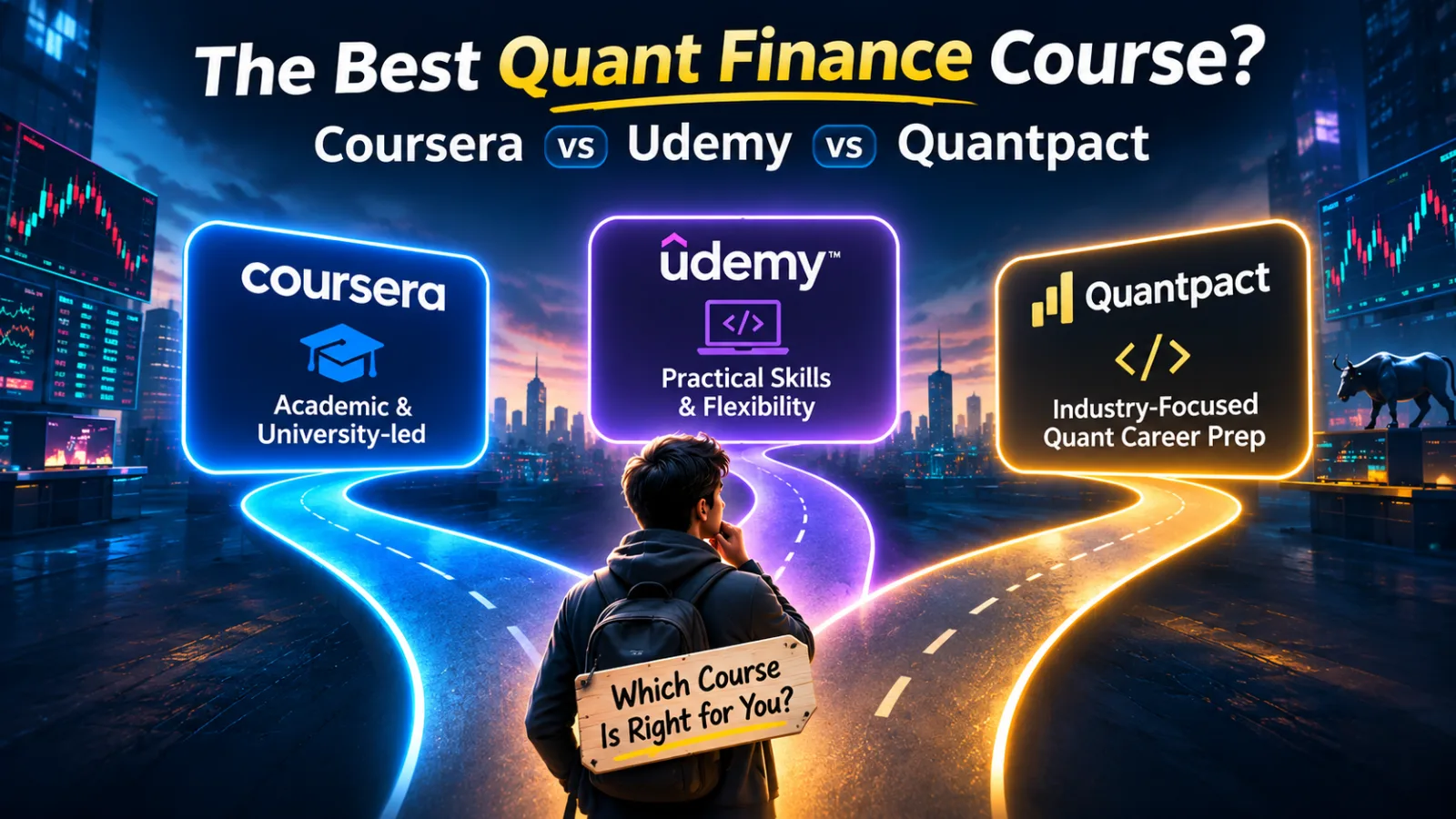
If you are serious about a career in quantitative finance, you have probably typed some version of the same question into Google: which quantitative finance course should I take? The results are crowded. University certificates, Udemy courses, Coursera specializations, bootcamps, YouTube playlists and mentor-led programs all promise to move you closer to a quant career.
But a better question hides underneath: which of these actually prepares you for what trading firms ask, and helps you get in front of them? Courses differ enormously on that, and the price tag tells you very little.
This guide compares the main types of quantitative finance courses honestly: what they teach, where they are genuinely strong, and where they leave gaps if your goal is a job as a quant developer. We also explain how our own mentor-led program at QuantPact is built, so you can judge whether it fits you.
First, decide what you are buying: exploration or a job
There are two very different intents behind a course purchase.
Exploring. You are curious about quantitative finance, you want to understand the concepts, and a career move is a maybe. For this, low-cost, self-paced courses are often the best value in education. You can sample topics, learn at your own speed and stop whenever you like.
Getting a job. You want to pass resume filters, technical screens, deep C++ rounds and system design interviews at quant firms and HFT companies. That needs more than knowledge. It needs projects, feedback on your code, interview practice and a resume that gets shortlisted.
Nothing here says marketplace courses are bad. It says they are built for the first intent, and many people buy them hoping for the second. This guide is about the second.
What most quantitative finance courses offer
The market is broad, but most courses fall into four types. Individual courses vary, so treat these as general patterns.
1. Theory-first courses. Derivatives pricing, stochastic calculus, Black-Scholes, portfolio theory and risk. These are valuable foundations and essential for quant researcher paths. They rarely touch production code, so they tell you little about how trading systems are actually built.
2. Python and machine learning courses. Pandas, NumPy, scikit-learn and backtesting libraries. They are accessible and good for strategy research. The limitation is that built-in libraries hide the details that matter in production, and Python does not run the latency-critical path at HFT companies. We unpacked this in Why Not Java or Python for Low-Latency Trading?.
3. University and platform certificates. Broad coverage and a recognizable name. They tend to move at an academic pace and are rarely aligned with what interviewers ask.
4. General coding bootcamps. Data structures, algorithms and web development. Useful for software engineering in general, but not tied to trading systems, memory behavior or low-latency design.
The pattern across all four is the same: strong on concepts, light on the execution layer, and quiet on interviews.
What quant developer jobs at HFT companies actually test
Quant developers at HFT companies build and maintain the software that sits closest to the exchange, where microseconds matter. That part of the system is called the execution layer, and it is written in C++. So interviews probe it directly:
- C++ depth: move semantics, RAII, templates, and what each feature costs on the hot path. Our C++ for Quantitative Finance roadmap lays out the topics that matter and the ones you can skip.
- Memory and cache behavior: where data lives and why allocation is expensive. A single
reserve()call can change worst-case latency dramatically, as we showed in std::vector in HFT. - Operating systems, concurrency and networking: what a system call costs, how threads hand data to each other, how market data and orders travel. See Operating Systems for Quantitative Finance Jobs.
- Trading system components: order books, order management, strategy and exchange connectivity. Start with Order Book in C++ for Quantitative Finance.
- System design: combining all of the above to design a low-latency system and defend every trade-off, as described in our quant developer system design interview guide.
Now compare that list with the four course types above. A candidate can finish a theory course and understand option pricing model, yet be unable to explain why that model is inefficiently implemented. A candidate can finish a Python machine learning course and build a backtest, yet have never written a line of C++ that handles real time market data.
Side-by-side comparison
The table below describes typical patterns, not every course. Marketplace courses win on price, flexibility and breadth, and we say so plainly.
| Factor | Typical self-paced course (Udemy, Coursera, others) | QuantPact mentor-led program |
|---|---|---|
| Main goal | Teach concepts to a broad audience | Get you ready for quant developer interviews and jobs |
| Taught by | Instructors recording for a wide audience | Mentors from the industry |
| C++ and the execution layer | Rare, or a short introduction | Taught in detail, as the core of the program |
| Where Python and ML libraries fit | Often the main subject | A supporting tool, not the destination |
| Doubt resolution | Q&A forums, variable response times | Doubts resolved within 24 hours |
| Progress tracking | Self-driven | Weekly calls to track progress and fix blockers |
| Industry trends | Rarely covered | Shared by mentors in the weekly calls |
| Interview preparation | Little to none | A central focus of the program |
| Resume | Not covered | Polished for ATS so it gets shortlisted |
| Industry connections | None | Internship pathways through industry partners |
| Price and flexibility | Low cost, fully flexible, huge catalog | Higher commitment, structured schedule |
How the QuantPact program is built
We built QuantPact around one question: what does a candidate need to get hired as a quant developer, and what is the fastest honest way to get there? Here is how that shapes the program.
Mentor-led, from the industry
The program is led by mentors from the industry, not by a recorded lecture series. That matters because quant development is full of judgment calls: which container, which thread layout, which trade-off. Judgment is learned by watching practitioners reason and by having someone challenge your reasoning.
Execution-layer C++, taught in detail
Most courses stop at theory or, at best, some Python with built-in machine learning libraries. That is far from what is applied in real quant jobs. We teach the execution layer in detail: modern C++, memory and cache behavior, concurrency, and how the components of a trading system fit together under latency constraints. The goal is that when an interviewer asks what happens when this function returns?, you can answer from understanding, not memory.
Doubts resolved within 24 hours
C++ is unforgiving. A confusing compiler message or a crash from undefined behavior can stall a learner for days, and stalled learners often quit. That is why doubts are resolved within 24 hours, so a blocker costs you an afternoon instead of a week.
Weekly calls: progress, blockers and industry trends
Every week, you get a call to track your progress, fix blockers and learn what is changing in the industry from the mentors. It gives the program a rhythm, keeps you accountable and connects what you study to what firms are actually doing.
Interview preparation as the main focus
The program is laser-focused on interview preparation. Everything taught maps to what is asked in quant developer interviews, from C++ deep dives to system design. You can see the style of questions in our quant developer system design interview guide, which shows how a strong answer ties every high-level decision to a low-level reason.
Resume polishing built for ATS
Many firms use applicant tracking systems (ATS) that scan resumes for keywords and structure before a human reads them. A resume with the wrong format or missing keywords can be filtered out, however strong the candidate. We polish resumes for ATS so that yours is shortlisted and your projects get seen.
Internship pathways through industry partners
With the help of industry partner connections, some of our students have secured internships at a crypto firm. Top performers are also offered internships with QuantPact partners. These pathways give learners real-world experience and a stronger story for full-time interviews.
Ten questions to ask any course before you buy
Whether you choose us or someone else, ask these:
- Who teaches, and have they worked at quant firms or HFT companies?
- Will I write C++ myself, or only watch someone else write it?
- Does it cover the execution layer: memory, cache, concurrency and most importantly the design of trading system components?
- Will an expert review my code and projects?
- How quickly are my doubts answered, and by whom?
- Is progress tracked, or am I on my own?
- How is interview preparation done, and does it match what firms ask?
- Will someone help with my resume and the ATS filters?
- Is the pace and cost realistic for my life and my goal?
If a course cannot answer these clearly, you have learned something important before spending a buck.
Which should you choose?
A self-paced marketplace course fits you if you are exploring, you want to understand the theory of quantitative finance, your budget is tight or you want to test your interest before committing.
A mentor-led, job-focused program fits you if you want a quant developer job, you need structure and accountability, you want to learn the execution layer in C++ in depth and you want interview preparation, resume help and industry connections in one place.
The two are not enemies. Many people start with marketplace courses to test their interest, then move to a focused program when they are ready to commit to the job.
FAQ
Is Udemy or Coursera enough to become a quant developer? They are useful for concepts and exploration, but most do not teach execution-layer C++, trading system design or interview preparation in depth. Most people need additional, job-focused training and projects.
Do I need a quantitative finance degree to get hired as a quant developer? Not necessarily. For developer roles, strong C++ and systems fundamentals, solid projects and clear reasoning often matter more than a finance degree, though requirements differ between firms.
How much C++ should a quantitative finance course teach? If the goal is a quant developer job, a lot: modern C++, memory and cache behavior, concurrency and low-latency design. A course that only mentions C++ in passing will not prepare you for those interviews.
What is an ATS, and why does it matter for my resume? An applicant tracking system screens resumes for keywords and structure before a recruiter reads them. A resume that is not built for it can be filtered out early, even if you are well qualified.
Is a mentor-led program worth it? It depends on your goal. If you are exploring, probably not yet. If you are aiming for a quant developer role, feedback, accountability and focused interview preparation can save months of trial and error.
Key takeaway
The best quantitative finance course is not the cheapest, the longest or the one with the most videos. It is the one that matches your goal. If your goal is a quant developer job, look for execution-layer C++, mentorship, fast doubt resolution, interview preparation and resume support.
That is the program we built at QuantPact, and the posts on this site give you a free taste of how we teach.